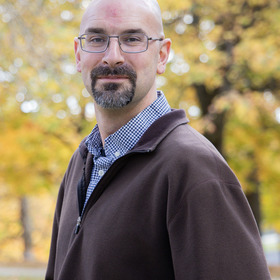
Hiram College Faculty and Alumni Publish Long-Term Study on Photosynthesis
Hiram, OH (10/30/2025) — Dr. Steven P. Romberger, Edward J. Smerek Chair in Mathematics, the Sciences, and Technology and associate professor of chemistry, recently published research studying photosynthesis in heliobacteria alongside five Hiram alumni in the journal Photosynthesis Research.
The article is the culmination of 11 years of work by Dr. Romberger and several Hiram students, who helped as research assistants. Students who worked alongside Romberger on this project were Tayleigh Price '24, Hallie Chavez '18, Alyssa Giudici '22, Alexus Acton '21, and Meaghan Stafford '24.
Not only does this publication mark a milestone in Dr. Romberger's career but it is also a testament to the commitment to hands-on learning offered to undergraduate students at Hiram. Many students enter Dr. Romberger's lab within their first year and begin fostering their curiosity and critical skills needed to succeed in future endeavors in STEM. Each student co-author on Dr. Romberger's research has taken the skills and knowledge developed in his lab and gone on to further their education or start a career in their desired field.
"Conducting research with Dr. Romberger was one of the most formative experiences of my academic journey. He has an incredible gift for fostering curiosity and independence in his students, and his mentorship truly shaped how I approach both science and problem-solving today," said Giudici.
Conducting research under the guidance of Dr. Romberger was one of the most formative experiences in my academic and professional development," Acton said. "Having that independent research experience at Hiram guided my decision to go to graduate school, and thankfully my time under Dr. Romberger prepared me for the professional responsibility and resilience needed in my next steps academically. I couldn't be more thankful for the research collaboration Hiram offered as collaborating on a publication further hones critical thinking and communication skills, to synthesize findings, interpret results, and present our conclusions clearly and effectively."
So, what did the team discover? This study investigates how heliobacteria-a group of photosynthetic bacteria-use light to power their metabolism. Specifically, it focuses on a key component in their photosynthetic machinery called P800, which is the primary electron donor in the heliobacterial reaction center.
When light hits P800, it becomes oxidized (loses an electron), initiating the conversion of light energy into chemical energy. Understanding how quickly and how much P800 becomes oxidized gives insight into how efficiently heliobacteria performs photosynthesis under steady light conditions.
Using live cells, the researchers measured how much of the P800 pool became oxidized during sustained illumination. They found that only about one-third of the P800 molecules were oxidized at a steady state and that the rate of the reaction could not be saturated, even under strong light. This indicates that the rate at which the reaction center captures light is the limiting step, not the downstream electron transport - as is the case in other photosynthetic organisms.
To confirm this, the team used charged redox reagents and electron transport inhibitors. These chemicals either enhanced or blocked the ability of cytochrome c to reduce the oxidized P800. While these treatments changed how much P800 remained oxidized, none changed the rate of P80 oxidation, supporting the idea that the system naturally operates well below saturation.
This behavior contrasts with plants and cyanobacteria, which rapidly oxidize their primary electron donors and need complex regulatory systems to manage excess light and prevent damage. The author's hypothesize that the heliobacteria avoid this problem by never reaching their photochemical limit, even when light is plentiful. This allows them to streamline their photosynthetic machinery, reduce the need for protective or repair mechanisms, and lower metabolic costs.
Rather than being adapted to low-light environments, heliobacteria thrive in high-light conditions-but use that light slowly and efficiently. Their minimalist approach offers a unique example of how nature can favor simplicity over speed and makes them an essential model for understanding the diversity of photosynthetic strategies.
For Dr. Romberger, having this work published after so many years of study has been intensely gratifying. However, one aspect sticks out to him more that others. "The most gratifying aspect is how deeply invested my co-authors remained in the work, even after graduation, and how big of an impact it had on their lives, helping to reaffirm career paths, inspire new ones, and exposing them to experiences and opportunities they never knew existed," Romberger said.
The Research Students
Each of the five alumni who published with Dr. Romberger played an intricate role in the completion and publication of the study during their time as Hiram students. All of these students has gone on to some form of further education either in Ph.D. or master's programs, physician's assistant programs, or veterinary school.
"I use the skills I gained from Romberger's lab every single day. Whether it's analyzing light curves for retinal evaluations or relying on the math foundations I built with him to calculate medications, the lessons from his classes continue to show up in my clinical work. In fact, one of his labs directly helped me recognize a complex case in the ER recently-proof that his teaching has a real-world impact even years later," Giudici said.
Tayleigh Price is currently enrolled in the physician's assistant program at Baldwin-Wallace University. She was a biology major at Hiram. Tayleigh presented some of this work at the Ohio Supercomputer Center Research Symposium and the Eastern Regional Photosynthesis Conference in 2023.
"I believe that the research I conducted in Dr. Romberger's lab set me apart from other students applying to PA school due to the unique experience I received while there. I was taught and honed my critical thinking skills, my ability to persevere and show grit, as well as traditional skills such as data interpretation and procedural skills for example. I was also taught how to believe in myself, and due to the confidence that Dr. Romberger instilled in all his students, it created an atmosphere to blossom within," said Price.
Hallie A.C. Chavez currently works for ASM International and is pursuing her masters in material sciences through Case Western Reserve University. Hallie was a biochemistry major at Hiram.
"My work on the heliobacteria study in Dr. Romberger's lab was instrumental in forging my career at ASM International. The hands-on experience I gained in experimental design, hypothesis testing, data analysis, maintaining a clean, well-documented lab environment, and mentoring new students in the lab translated directly into my role as a material science technician and educator in a professional training lab," Chavez said.
Alyssa J.L. Giudici is currently in veterinary school at Cornell University. She was a biochemistry and neuroscience double major at Hiram.
Alexus Acton is currently employed by MedPace. She recently earned her Ph.D. in biochemistry, structural biology, and molecular genetics from the University of Alabama - Birmingham. She was a biochemistry and biology double major at Hiram.
Meaghan Stafford is currently in veterinary school at Lincoln Memorial University. She was a biochemistry major at Hiram. Meaghan presented some of this work at the Choose Ohio First Showcase and the Ohio Academy of Sciences Annual Meeting in 2023.
"Conducting research with Dr. Romberger was one of my most pivotal experiences at Hiram College. It gave me opportunities and experiences that would not normally have been available to me. I learned about advanced scientific research, working as part of a research team, and the publication process," Stafford said. "I also had the opportunity to present my research at several scientific conferences, including presenting at the state capital to the lieutenant governor of Ohio. This experience gave me invaluable credentials that helped me when applying to professional school."
The full research publication of their work can be found here.